
Updated for 2026
PhilHealth ID 2026 | Requirements, How to Get It, and Is It a Valid ID?
The PhilHealth ID is free, and the 12 digit number on it matters more than the card. Here is everything: requirements, how to get one, the ID size, front and back, cost, validity, and what to do if you lose it.

The PhilHealth ID is free, and the small plastic or paper card matters far less than the 12 digit number printed on it. Most people who search for a PhilHealth ID actually need two things: proof of membership they can hand to a hospital, and the PhilHealth Identification Number that unlocks their benefits.
This guide covers all of it. What the PhilHealth ID is, the two types you can get, the exact requirements, how to get one online or at a branch, the ID size and photo specs, what the front and back look like, what it costs, whether it counts as a valid ID, and what to do when you lose it. No mystery, no runaround.
A PhilHealth ID is the membership card issued by the Philippine Health Insurance Corporation (PhilHealth) that shows your name, photo and PhilHealth Identification Number (PIN). The paper member ID is free and released at any PhilHealth branch once you have your PIN. It is a government issued ID, though many institutions accept it as a secondary ID rather than a primary one.
What Is a PhilHealth ID?
A PhilHealth ID is the official membership card of the Philippine Health Insurance Corporation, better known as PhilHealth or PHIC. It confirms that you are a registered member of the national health insurance program, sometimes called the Insurance Card ng Bayan. The card carries your full name, your PhilHealth Identification Number, and your photo and signature.
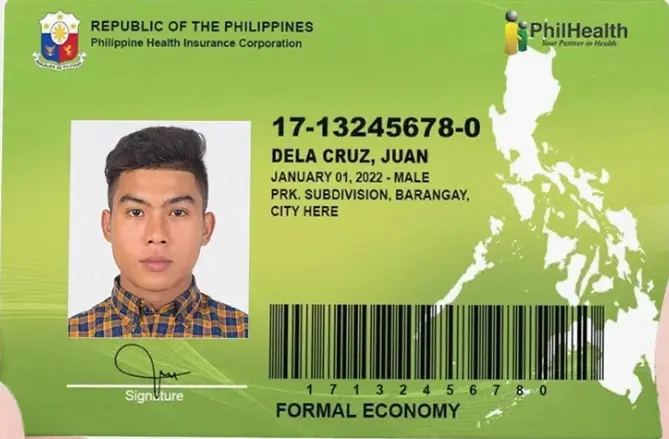
People use a few names for the same thing. PhilHealth ID, PhilHealth ID card, PhilHealth card, PhilHealth insurance card, and phic id all point to the same membership card. Whatever you call it, its job is simple: it proves you are a member so a hospital or clinic can apply your benefits, and it serves as a valid government issued ID for everyday transactions.
Here is the part most guides bury. The card is proof, but the PhilHealth Identification Number on it is what actually runs your coverage. That distinction matters, so it gets its own section next.
PhilHealth ID vs Your PhilHealth Number (PIN): What Actually Matters
Your PhilHealth Identification Number, the PIN, is a permanent 12 digit number issued to you once and kept for life. It never changes, even if you switch employers, move abroad, or lose every card you ever had. Hospitals, employers and PhilHealth itself use this number, not the plastic, to find your record and apply your benefits.
The physical PhilHealth ID is a convenient way to carry and prove that number. Useful, but replaceable. If you know your PIN and your record is active, you can be admitted to a hospital and have your benefit applied even without the card in your wallet.
So who issues it? PhilHealth, a government owned corporation, issues both the number and the card. When people ask about the issuer of the PhilHealth ID, that is the answer. Keep your PIN written down somewhere safe. The card you can always reprint or replace.
The Two Types of PhilHealth ID: Paper vs PVC
There are two versions of the PhilHealth ID, and knowing the difference saves you a wasted trip. One you can almost always get today. The other you may not get at all, depending on your branch.
The Paper-Based Member ID
This is the standard PhilHealth ID that offices issue over the counter. It is printed on cardstock or paper, carries your PIN, name and signature, and has a space for your 1 by 1 photo. It is free, and most people laminate it so it survives a wallet. When a branch says your ID is ready the same day, this is the one they mean.
The Digitized PVC ID Card
The PVC card is the hard plastic version, similar in feel to a bank card or driver’s licence. It looks more official and lasts longer. Here is the honest part: nationwide issuance of the digitized PVC PhilHealth ID was suspended back in 2017, so many branches simply do not produce it anymore. Where it is still offered, it carries a small fee. Do not travel to a branch expecting a PVC card without calling ahead to confirm they issue it.
For almost everyone, the practical move is to get the free paper member ID now, and print the digital member ID from your online account for backup. Chase the PVC card only if your branch confirms it is available.
| Feature | Paper member ID | Digitized PVC card |
|---|---|---|
| Material | Paper or cardstock | Hard plastic (PVC) |
| Cost | Free | A fee applies (around ₱90 where offered) |
| Where to get | Any PhilHealth branch, same day | Selected branches only, if available |
| Availability | Widely available | Limited; issuance suspended nationwide in 2017 |
| Durability | Low (laminate it) | High |
| Best for | Everyone, immediate proof | Those whose branch still issues it |
PhilHealth ID Requirements (2026 Checklist)
The PhilHealth ID requirements are light, which is why the card is so easy to get once you know what to bring. What you need depends on whether you already have a PhilHealth number.
Requirements for New Members
If you do not have a PhilHealth number yet, you register and claim your ID in the same visit. Bring:
Requirements for Existing Members (You Have a PIN)
If you already have a PhilHealth number and just want the card, bring:
Requirements to Replace a Lost ID
Lost your card? The lost PhilHealth ID requirements add one document:
A quick note on the valid ID you present. Any government issued ID works: passport, driver’s licence, UMID, PhilSys national ID, or postal ID. Make sure the name on it matches your PhilHealth record exactly, because a mismatch is the number one reason applications stall.
How to Get a PhilHealth ID: Step by Step
So how do you get a PhilHealth ID? The physical card is claimed in person at a PhilHealth office. There is no fully online path to a printed card yet, though you can print a digital member ID from your account, which the next section covers. Here is the branch process in four steps.
Step 1: Prepare Your Requirements
Gather everything from the checklist above based on your situation. If you are a new member, fill out the PMRF completely and copy your name exactly as it appears on your birth certificate. Bring an original valid ID and a photocopy, plus your 1 by 1 photo.
Step 2: Go to the Nearest PhilHealth Office
Visit any Local Health Insurance Office. If you are wondering where to get a PhilHealth ID, or saan pwede kumuha ng PhilHealth ID, the answer is any PhilHealth branch, not just the one nearest your home. Go early. Mid morning to mid afternoon is the busiest window, and arriving when doors open saves you an hour of waiting.
Step 3: Submit Your Documents (and Get Your PIN if New)
Hand your PMRF and requirements to the counter. New members are issued their permanent PhilHealth Identification Number on the spot. Existing members simply confirm their PIN. Review every detail the staff encodes, because your name spelling and birth date must be correct before anything is printed.
Step 4: Receive Your PhilHealth ID
Once your details are verified, the office prints and releases your paper member ID. In most cases this happens the same day. Sign it, then laminate it when you get home so it lasts. That is the whole process for how to make a PhilHealth ID.
How to Get a PhilHealth ID Online
You cannot have a physical card mailed to you from a website, and that is worth stating plainly because a lot of searches for how to get a PhilHealth ID online end in disappointment. What you can do online is generate and print a digital member ID from the PhilHealth Member Portal, which works as proof of membership in many situations.
- Log in to the Member Portal at memberinquiry.philhealth.gov.ph with your email or PIN and password
- Open your Member Data Record or the member ID section
- Check that your name, PIN and details are correct
- Use your browser to save the page as a PDF, then print it
If you have not registered for online access yet, start with our full guide to PhilHealth online registration, then come back and print your member ID. For anything the digital version cannot do, such as a laminated card a guard will accept at a glance, visit a branch for the paper ID. Online PhilHealth ID replacement follows the same idea: reprint the digital copy immediately, then file for a physical replacement at a branch.
PhilHealth ID Size, Format and Photo Specifications
This is the detail most guides skip, so here it is clearly. If you are printing, laminating, or preparing a photo, these are the numbers you need.
| Specification | Detail |
|---|---|
| Card size (PVC / standard) | About 85.6 mm by 54 mm, which is 3.375 by 2.125 inches, the same size as a credit card or driver’s licence |
| ID photo size | 1 inch by 1 inch (1 by 1), recent, front facing, white background |
| Paper member ID | Printed on a standard PhilHealth form; members usually trim and laminate it to card size |
| Orientation | Landscape, with the photo and details on the front |
When people search for the PhilHealth ID size in inches or in cm, the standard card follows the same dimensions as most Philippine IDs, roughly 3.375 by 2.125 inches or 8.56 by 5.4 centimetres. For the picture, a plain 1 by 1 ID photo is all you need, the same size used for most government forms.
What the PhilHealth ID Looks Like: Front and Back
Knowing what a real PhilHealth ID looks like helps you check that yours was printed correctly, and helps you recognise a fake. Here is the layout, front and back.
Front of the Card
The front carries the PhilHealth logo, the label identifying it as a member card, your full name, your PhilHealth Identification Number, your 1 by 1 photo, and your signature. On the paper member ID, the photo is attached in a marked space and the card is signed by the member.
Back of the Card
The back is usually plain or carries brief text, and on some versions it includes the member’s address or a reminder about the number. When people search for the back of a PhilHealth ID or PhilHealth ID front and back, they are usually confirming that a card is complete, not looking for hidden information.
One honest caution
You will see searches for a PhilHealth ID template or a printable PhilHealth ID. We describe the official layout here so you can recognise a genuine card, but we do not provide editable templates, because creating a fake government ID is a crime. If you need a card, get the real one at a branch. It is free and takes an afternoon.
How Much Does a PhilHealth ID Cost?
The paper member ID is free. That is the short answer to how much a PhilHealth ID costs, and it is worth repeating because scam fixers sometimes charge for it. Is the PhilHealth ID free? Yes, the standard member card is free of charge at any branch.
The only version that has ever carried a fee is the digitized PVC card, which cost around ₱90 before nationwide issuance was suspended in 2017. Where a branch still offers it, expect a small fee in that range. Anyone asking you to pay for the ordinary paper ID is overcharging you.
Is the PhilHealth ID a Valid ID?
Yes. The PhilHealth ID is a government issued ID, so it counts as valid identification. The honest, useful version of the answer is this: it is widely accepted as a secondary ID, and for many everyday transactions it is enough on its own, but some institutions, particularly banks and passport applications, prefer or require a primary ID with more security features.
In practice, treat your PhilHealth ID as a solid supporting ID. It works well alongside a primary ID such as a passport, driver’s licence, UMID or the PhilSys national ID. If a transaction is high stakes, like opening a bank account or applying for a passport, carry a primary ID too. For clinics, employers, and most government offices, the PhilHealth ID on its own is usually accepted.
So when someone asks is PhilHealth a valid ID, or whether PhilHealth is a government ID, the answer is yes on both counts. Just know the difference between primary and secondary acceptance so you are never caught short at a counter.
How to Replace a Lost or Damaged PhilHealth ID
Do not panic. Losing the card does not lose your membership, and it certainly does not lose your PhilHealth number, which is permanent and safely stored in the system. Replacing a lost PhilHealth ID is straightforward.
- Reprint your digital member ID from the Member Portal right away, so you are never without proof
- Prepare a notarised affidavit of loss, a valid government ID, and your PIN or MDR
- Visit any PhilHealth branch and request a replacement, bringing a recent 1 by 1 photo
- Pay the replacement fee if your branch charges one, then receive your new card
That covers the common questions: what to do if you lost your PhilHealth ID, whether you can get another PhilHealth ID if you lost it, and how to get a PhilHealth ID if lost. The answer to all three is yes, you can replace it, and your number stays the same. Call the branch first to confirm whether they need the affidavit and what the reprint fee is, so you only make one trip.
How Long Does It Take to Get a PhilHealth ID?
For the paper member ID, the honest timeline is same day. Once your details are verified at the counter, the office prints and releases the card within the same visit, often inside an hour depending on how busy the branch is. If you arrive late in the afternoon, you may be asked to return the next day, so go in the morning.
The PVC card, where it is still issued at all, takes longer because it is produced in batches, and availability varies by region. If your branch offers it, ask for their current processing time rather than assuming.
PhilHealth ID for Dependents and Senior Citizens
Qualified dependants, such as a spouse, children below 21, and parents aged 60 and above, are listed on the principal member’s record and Member Data Record. They are covered through the member and do not each carry a separate member ID in the same way. If a dependant later becomes a member in their own right, they register and get their own PhilHealth Identification Number and card.
Senior citizens aged 60 and above are covered as members with premiums paid by the government, and they are entitled to their own PhilHealth ID. The requirements are the same, with a valid ID and a 1 by 1 photo. Getting the card is a five minute errand that saves confusion later at a hospital counter.
Common PhilHealth ID Problems and Fixes
Most PhilHealth ID problems have a simple cause. Here are the ones that send people home empty handed.
You do not have a PIN yet. You cannot get the ID without a PhilHealth number. Register first, in the same visit, using a completed PMRF.
Your name does not match. If the name on your valid ID differs from your PhilHealth record, even by a missing middle name or a suffix, the office may hold the card until the record is corrected. Fix the record first.
The PVC card is not available. Many branches no longer print the plastic card. Take the free paper ID and print the digital version rather than travelling branch to branch chasing a PVC card.
Verification fails online. If the Member Portal will not confirm your details, your account may not be activated or the spelling may differ from your record. Sort the account out first, then print the digital ID.